
Health care can be a source of anxiety for many people, especially if needed when outside of their home country.
You don’t know exactly how everything works, how much of a language barrier there will be, and how the manner of care will compare to your homeland.
It’s easy to put off routine care visits for any number of reasons and before you know it a shocking length of time has gone by since your last visit!
Not speaking from experience at all… =)
At any rate, as far as medical exams go, an eye exam seems like one of the least intimidating to check off the list together with a dental exam, but I think the majority of people would disagree with me on the latter.
So whether you’re visiting Portugal, thinking of moving to Portugal, or just curious what the cost of eye care is in Portugal, this article is for you!
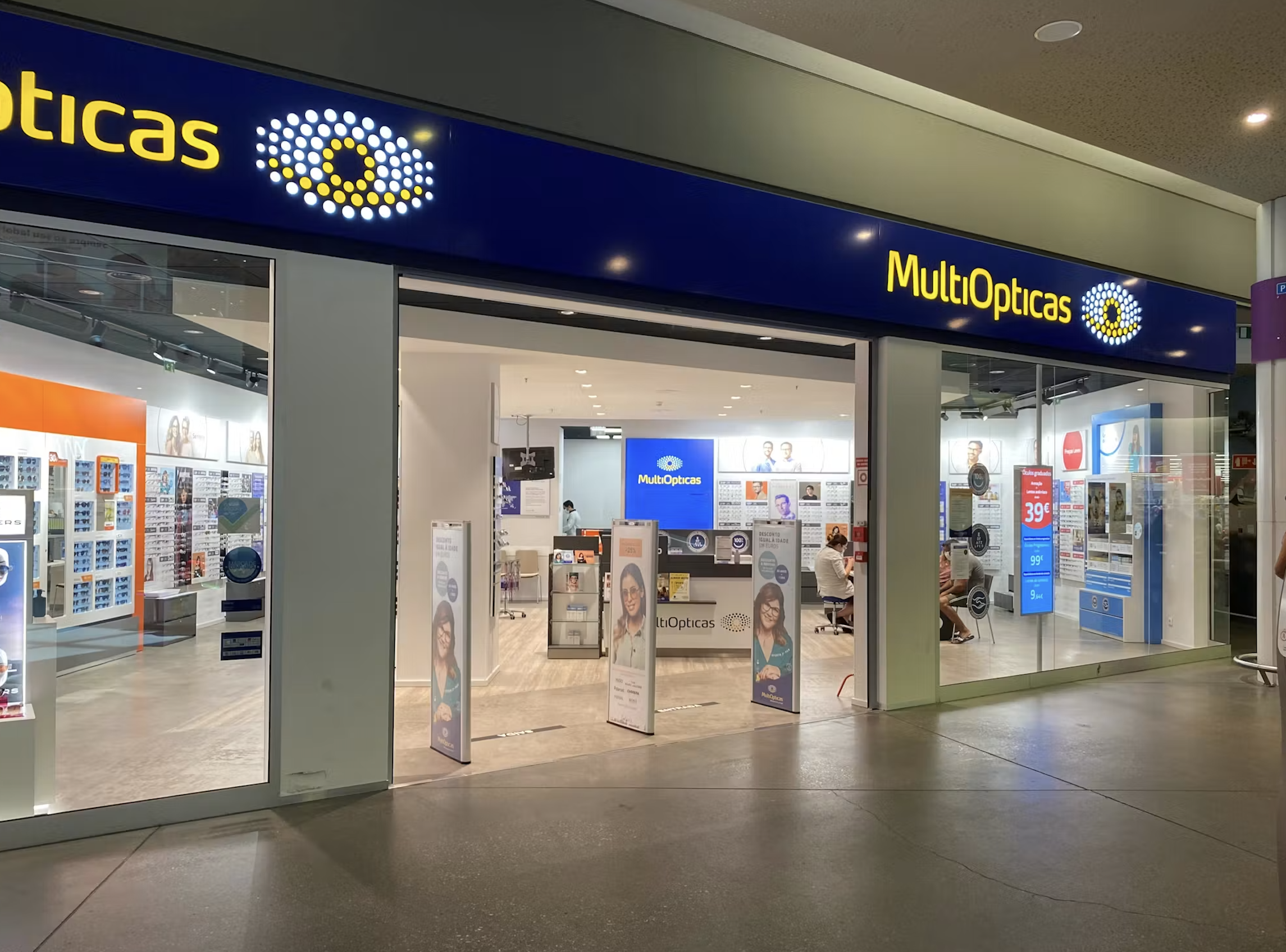
I’ll be sharing my first hand experience at MultiOpticas in Portugal as well as answering some of the most frequently asked questions about vision care in Portugal.
How Much Does an Eye Exam Cost in Portugal?
This is probably the number one question people are curious about and the answer is two-fold.
The cost of an eye exam in Portugal is going to vary based on the type of exam you need and the type of clinician who performs the exam.
Eye Exams by an Ophthalmologist in Portugal
For example, if you have an eye exam by an Ophthalmologist in the private health care system you’re likely to pay between 70-100 euros out of pocket for your consultation.
If you have private insurance coverage your co-pay may only be 15 or 30 euros.
Of course, if your exam requires more in-depth diagnostics you will have additional expenses.
Visiting an ophthalmologist under the national health service, SNS, may be free or have a small fee of around 20 euros.
The catch with using the national health service (if you qualify to) is always the wait times. Some folks wait up to a year for their eye exam.
Eye Exams by an Optometrist in Portugal
On the other hand, you may choose to have an eye exam performed by an Optometrist in Portugal.
This type of eye exam will help you determine your current glasses and/or contact prescription and check some basic eye health.
Many optometrists work in commercial spaces that also sell glasses, contacts, and related items, very similar to a Pearle Vision or even a Walmart Vision center.
How much are eye exams by an optometrist in Portugal?
In many of these commercial spaces, the eye exam is provided for free.
You will often see a sign in the window advertising free vision exams in Portugal.
Are the eye exams really free in Portugal?
Yes! You really can get a free eye exam in Portugal in many spaces, and I will be sharing my experience doing so at MultiOpticas.
Where Can You Get an Eye Exam in Portugal?
Again, you can go to the medical office of an Ophthalmologist which could be a standalone location, inside a hospital, or inside a clinic.
You can also choose to visit an optometrist which can also be located in a standalone office space or in a commercial space such as a shopping mall.
Almost every shopping mall in Portugal will have at least one optometrist if not several.
For example, at Tavira Plaza in Algarve there are at least 2 commercial optometrist locations as well as a clinic where you could see an Ophthalmologist.
Additionally, many grocery stores have inside of them a sort of “wellness” store which is kind of like a CVS/RiteAid/Walgreens pharmacy.
They aren’t necessarily a true pharmacy where you can fill your prescriptions but have similar products to the above mentioned stores Americans are familiar with.
Inside these little stores within grocery stores you can also find a corner where an optometrist works as well!
And in fact, most malls have a major grocery store attached. So that is an additional place you can get your eyes examined in Portugal.
Optometrist vs. Ophthalmologist in Portugal: What’s the Difference?
This is a good question.
Generally an optometrist focuses on performing routine eye exams and vision test and diagnoses nearsightedness, farsightedness, glaucoma, dry eye and similar conditions.
They are going to prescribe your corrective lenses (glasses & contacts).
During their exams they also screen for other systemic diseases like high blood pressure and diabetes.
Did you know they can identify those things by just looking at your eyes!?
On the other hand an Ophthalmologist is usually your go-to for more complex eye conditions that need monitoring over time as well as those that may need surgery.
Should I See an Optometrist or an Ophthalmologist?
For most people the first point of contact in vision care is going to be the optometrist.
When you feel you’re squinting a bit too much or sensing eye strain and fatigue on the daily, it may be that your corrective lenses need adjustments.
In that case you’ll head to the optometrist.
Should they see something of concern, they will likely refer you to follow up with an ophthalmologist.
If you have other known chronic visual concerns then you may choose to skip straight to an ophthalmologist both to evaluate your corrective lenses prescription and your eye diagnoses.
What Happens During an Eye Exam in Portugal?
I was really curious to know what happens during an eye exam in Portugal and how it compared to the ones I had in the US.
Overall I would say it was pretty much exactly the same as I remembered!
You’ll do a glaucoma test, have your intraocular eye pressure measured, you’ll do everyone’s favorite exam seeing how well you can read the letters from across the room without glasses and then the optometrist will gradually adjust the lenses to identify when you see clearest and determine the appropriate lens power for you.
Do You Need a Prescription to Buy Glasses in Portugal?
I actually don’t know for sure but I am going to say yes because how can you know what to order if you don’t have a prescription?!
No but seriously I know sometimes you have your previous prescription and you just want to order new glasses with it.
The thing is… if you can get a free eye exam to confirm the prescription before buying a new pair, why wouldn’t you!?
Can You Get an Eye Exam Through Portugal’s Public Healthcare System (SNS)?
Absolutely you can get an eye exam through Portugal’s Public Healthcare System!
Again, for those who qualify, you may be able to get a free eye exam or a very low-cost exam through the SNS, however bear in mind that you may wait for many months to receive an appointment.
Sometimes, when the day finally arrives for your appointment you will go to the office only to find it has been canceled and may or may not have been rescheduled.
For reasons like these some choose to pay out of pocket for their eye care in Portugal even if they qualify to use the national health system.
My Experience Getting an Eye Exam in Portugal — MultiOpticas Review
Medical Disclaimer: This is my personal experience and isn’t medical advice. The tests and recommendations you receive may vary depending on your circumstances.

I finally decided to bite the bullet and make an appointment for an eye exam.
I knew there was a MultiOpticas location in our local mall and a friend of mine had just mentioned that she had gone there for years in Spain.
Conveniently, you can make an appointment right on the MultiOpticas Portugal website.
There was plenty of availability.
As a matter of fact, I was able to secure an appointment at a convenient time the very next day!
Upon arrival to MultiOpticas (in a shopping mall in Portugal) an employee was able to do the intake form right away even though I was a bit early.
I had next to no wait time before the Optometrist called me in.
She first asked how she could help and was interested in medical history, prescriptions, or eye concerns I might have.
I will also add that she was very willing to both speak in English or speak in Portuguese when I told her I was learning.
For the record, we did the entire exam successfully in Portuguese (thanks to her patience!) with the exception of few questions I had at the very end.
So, we started with the favorite eye puff test aka non-contact tonometry (NCT) or air puff tonometry.
This is the test where you look into the machine and focus on the little hot air ballon and suddenly there is a quick burst of air.
This test screens for high eye pressure and helps to detect early signs of glaucoma.
She also used the machine to take a good look at my eyes after the puff test.
Next we went to reading the chart of letters across the room.
Of course I can see absolutely nothing so she started with my current prescription of corrective lenses.
The difference here from my past eye exams in the US was that I put on a pair of glasses that she manually added and took away the lenses from.
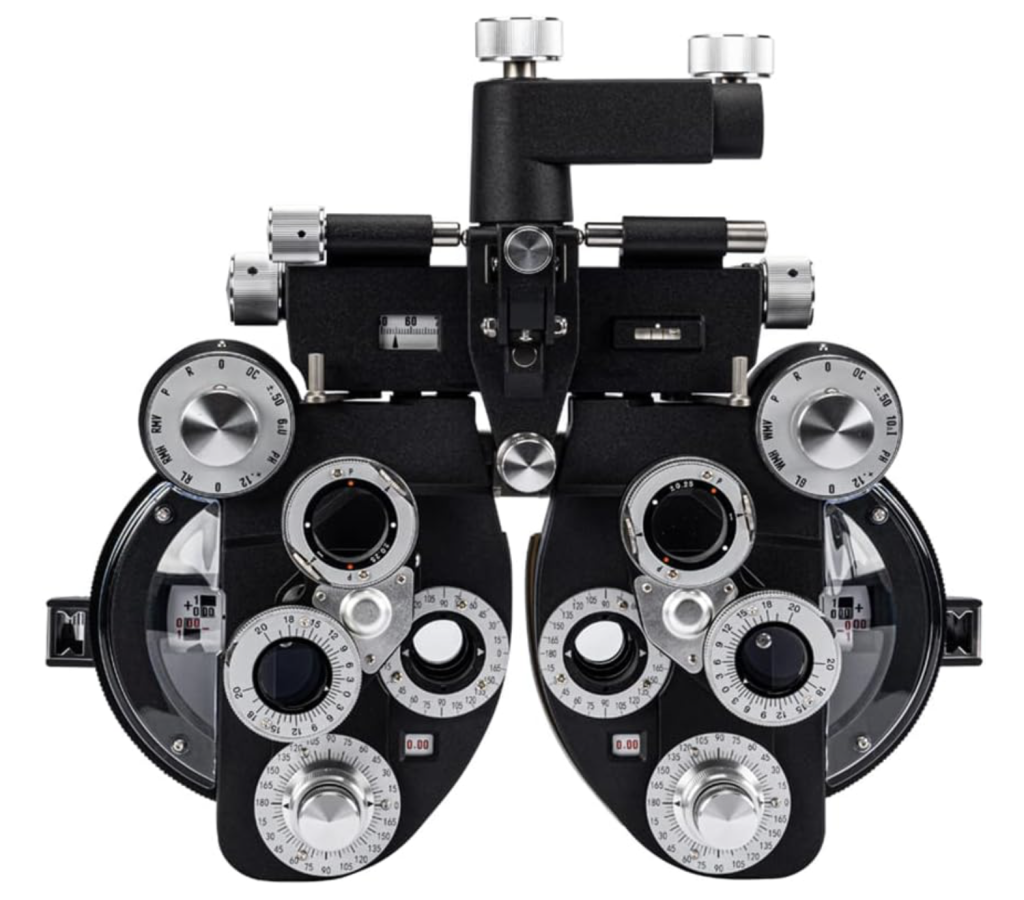
In my previous eye exams you don’t put on a set of literal glasses to do this, but you have them brought to you on the … hold on, let me google this …
I guess its called a phoropter the device where you put your chin and forehead against it and all the lenses are built in and they flip through them and ask you if you can see better “now or before or is it basically the same.”
You know the thing I mean right?
Anyways at the end of the exam she discussed any changes in my corrective lens power and asked if I had any questions.
I did have a couple of questions which let her to grab an ophthalmoscope and do an additional test.
She recommended I follow up with an ophthalmologist for a more comprehensive exam.
I thought the exam experience was excellent. The clinician was not rushed. I felt she took her time to perform the exam thoroughly and answer any questions I had until I had no further questions.
She also ordered me contact lenses in my new prescription to test as they did not have my needed power in stock.
In the end it was a successful medical maintenance visit and simultaneously a practical real-world Portuguese language lesson with lots of conversation and alphabet practice.
Pro Tip: Practice how to say letters H, K, and Z in Portuguese before you go. Those were the ones I kept getting stumped on, laughing, and reverting to English.
Can You Get an Eye Exam in Portugal Without Speaking Portuguese?
Absolutely you can.
And if that is your need, I recommend contacting the location ahead of time.
But overall, you’re most likely to find someone who speaks English in a commercial location like MultiOpticas, and definitely in any areas with major concentrations of foreigners like Lisbon, Algarve, Silver Coast etc.
It’s not a guarantee, but it is very likely.
What if no English Speaking Clinician is Available?
This is a very valid concern and a possible scenario depending on where you are.
My top recommendations are to prepare in advance what you might need to say and even use google translate (or your preferred translator) to type up any questions and concerns you have and print it out in advance to bring with you.
During the exam you can use a translator app to live translate back and forth with your clinician.
It is very doable, you may be surprised!
Should I Attempt My Appointment in Portuguese?
Needless to say, that’s up to you!
I really recommend to try to do as much as you can in Portuguese so that you can practice and be immersed in the language.
I like to tell people upfront I am still learning Portuguese but I would like to practice.
At any time you don’t understand, feel free to ask them to repeat themselves or say plainly that you don’t understand.
Remember, you can always revert to English if you need to and you will still have gained a lot of benefit in the Portuguese you were able to practice.
It’s also a great way to show respect to the Portuguese people as guests in their country.
Still, at the end of the day your health is a very important subject to understand well. So whatever language or combination of languages you choose to use, please be sure to leave your appointment feeling comfortable and confident with the care and information you have been given.
How to Find an English-Speaking Optometrist or Ophthalmologist in Portugal
Well I think I touched on this a bit already, but repetition for emphasis.
Simply ask if there is an English speaking provider available when you try to make an appointment.
Remember that you’re most likely to find English Speaking providers in areas concentrated with foreigners as English is often a lingua franca, meaning it’s the shared language most commonly spoken amongst people who speak other languages.
Also do a classic google “English Speaking Optometrist / Ophthalmologist in ______” and fill in the blank with your location.
Eye Exams in Portugal vs. the United States: What’s Different?
My experience was largely the same.
I felt the standard of care was excellent.
The tools were basically the same except for the phoropter being a literal pair of glasses you put on and then the optometrist adjusted the lens power compared to a tool you lean your face against directly.
Cost. I’d say cost is a difference. I personally never had a free eye exam in the United States. Any commercial space I ever went to charged an exam fee as well as whatever you decided to buy (if anything) after the exam.
Do You Get a Prescription After an Eye Exam in Portugal?
After my free eye exam at MultiOpticas I wasn’t specifically handed my prescription.
I also didn’t ask for it.
When I go back to the store I am going to ask for it to see if they give it to me.
I was curious if, because the exam is free, they will not surrender the prescription details in an effort to encourage purchasing within their brand.
I am also curious if they will provide the written prescription after you make a purchase.
I do believe they should provide you with the prescription as a patient should be able to keep it as part of their personal health records.
Are You Pressured to Buying Eye Glasses at MultiOpticas?
Since my exam was done for free at a retail space, I was wondering how pressured I would feel to buy eye glasses and/or contact lenses at MultiOpticas.
Here’s my experience:
After my exam, the optometrist told me to have a seat at one of the desks and that her colleague would be over shortly. She provided her colleague with the form from my visit containing my prescription.
This was the same woman who had checked me in. She was very calm and kind, also supportive of practicing Portuguese.
She took time to explain to me +MultiOpticas Visual Health Plan.
+MultiOpticas Visual Health Plan
This is basically a sort of insurance plan meets payment plan meets glasses pseudo-rental.
The plan starts at 9 euros per month over 24 months.
You get 2 pairs of glasses at the start of the plan. The prescription glasses can be regular glasses, sunglasses, transition lenses, whatever you want.
You start with two pairs.
Any time your lens prescription changes, you get your lenses updated for free.
So that’s nice, because the lenses themselves are always so expensive.
There are also various coverages for if they get broken, scratched, lost or stolen.
After the first year you can change/upgrade your glasses.
Every time you do this, you extend the plan for an additional year.
Important to know: If you ever decide to leave the plan you have to return the glasses.
So this plan can be nice if you wear your glasses all day every day, enjoy changing frames often, and it can be a good value since any lens changes needed are always included. You simply pay a monthly price and know your eyes are covered.
After explaining the plan to me and the layout of the glasses in the store, I was invited to look around.
I looked around and tried on many pairs and ironically the first 2 pairs I liked most were the cheapest section of frames.
I actually thought that was just fine since I mainly wear glasses at home and when using the computer and wear contact the rest of the time.
The associate gave me a quote and explained that the cheapest frames don’t have a lens discount.
So we then looked for similar frames at a higher price point around the store.
She then ran 2 quotes for me — The monthly price for the 2 pairs under the MultiOpticas Visual Health Plan (I think it was around 35 euros/month over 2 years) and the price for one pair of glasses paid out right.
I was not ready to make a decision at the moment so she gave me the quotes, information about the Visual Health Plan, and let me know that if I decided to proceed with either option everything would already be in the computer system.
I really did not feel pressure from the sales team to make a purchase and ironically, that fact alone made me more likely to make a purchase. Take note businesses! lol
I felt she they did a great job explaining the options to me, showing the benefits of the visual plan and how it makes sense for many people, without pressuring me to feel I needed to choose that plan or to buy a pair of glasses that very day.
In my personal experience I would say no, I did not feel pressured to buy glasses at MultiOpticas in Portugal. YMMV.
I hope this helps you feel a little more prepared ahead of your first eye exam in Portugal. Don’t worry, you’ve got this! =)
Frequently Asked Questions
- Can you get an eye exam for free in Portugal?
- Yes! Many standalone and commercial stores selling eyewear offer free eye exams by an Optometrist.
- What does an optometry exam include?
- In addition to establishing your corrective lens prescription (if needed), the exam will check your eye pressure, any signs of glaucoma, and even systemic conditions like diabetes.
- Is MultiOpticas actually free?
- Yes. Your eye exam is absolutely free. If you choose to by glasses, that’s another story. =)
- Do you receive your prescription?
- I did not receive a copy of my prescription after my exam. I also did not ask for it.
- How much do glasses cost?
- The cost of glasses varies wildly depending on whether or not you have any applicable medical insurance coverage, which frames you choose, what type of lenses you require and so on. I would recommend budgeting 400 euros per pair.
You may spend much more or much less depending on the specifics.
- The cost of glasses varies wildly depending on whether or not you have any applicable medical insurance coverage, which frames you choose, what type of lenses you require and so on. I would recommend budgeting 400 euros per pair.
- How much are contact lenses?
- Oops, I actually didn’t check!
- What’s the difference between an optometrist and ophthalmologist in Portugal?
- Optometrist will do you basic eye exam and Ophthalmologist will provide more in-depth exams and care for chronic eye conditions, even performing eye surgery at times.
- When would you need an ophthalmologist?
- If you have serious eye concerns, conditions like glaucoma, cataracts, high intraocular pressure, diabetic retinopathy, macular degeneration, macular edema etc.
- How do you get a more comprehensive eye examination?
- If you need a more comprehensive eye examination in Portugal you should see an Ophthalmologist.
- Is private ophthalmology expensive?
- A general exam may cost you 70-100 euros without insurance. Additional testing and interventions will increase this amount.
- Can you get eye care through the Portuguese public system?
- Absolutely, but you may have a long wait. YMMV
- What happens if an optometrist discovers something abnormal?
- They will refer you to see an Ophthalmologist for further testing and treatment.
- Do you need to buy glasses from the place that tested you?
- Not necessarily.
- How does the experience compare with eye exams in the US?
- Very similar experience, high quality care.
The +MultiOpticas Visual Health Plan: Is It Worth It?
I can see how this visual health plan can make a lot of sense for many people in Portugal.
Especially for anyone who frequently updates their eyewear frames and who has frequent prescription changes, it could definitely be worth it.
In my case, it was not the right fit for my personal needs at this moment.
I recommend evaluating everything the plan offers and your personal needs to see if it’s the right fit for you!
















Leave a Reply